
Learn more about Hornsey Foodbank
Hornsey Foodbank is an independent, community-led organisation working to support people facing food insecurity in Hornsey and the surrounding areas. We believe that everyone deserves access to nutritious food and practical support and to be treated with dignity and respect.
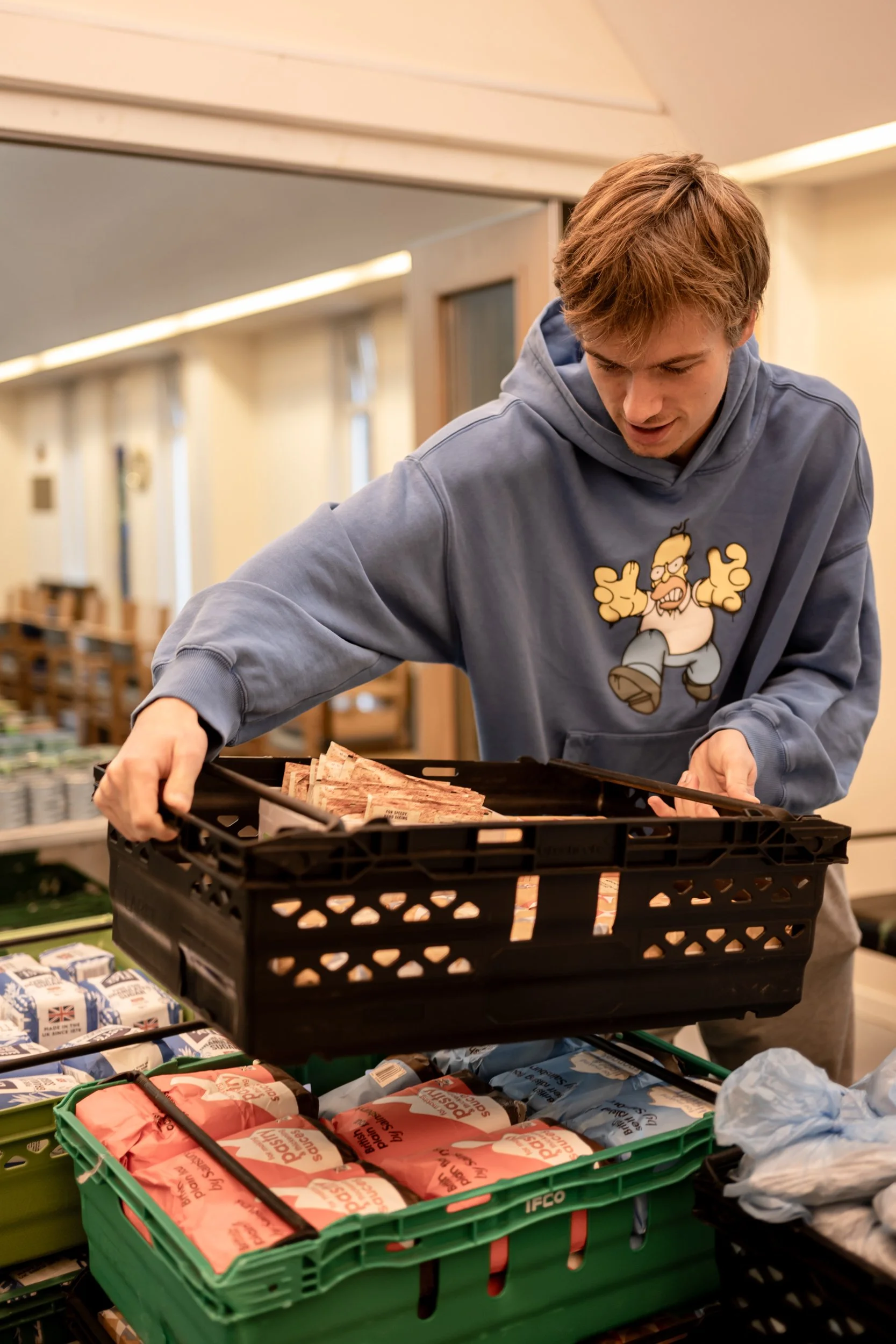
Our story
Hornsey Foodbank was established in response to growing need within our local community. What began as a small, grassroots effort has grown into a vital volunteer-led service supporting our neighbours through difficult times.
Rooted in the local area, we work closely with community organisations, referral agencies and volunteers to ensure that people experiencing hardship can access food and support when they need it most. Our work continues to evolve as needs change, but our commitment to the community remains at the heart of everything we do.

Mission & values
Our mission
To relieve food poverty in our local community by providing emergency food and support, while treating everyone with compassion, dignity, and respect.
Our values
Dignity – We believe everyone deserves to be treated with respect, without judgement or stigma.
Community – We are rooted in our local area and work collaboratively to support one another.
Compassion – We listen, care, and respond with kindness and understanding.
Integrity – We operate transparently, responsibly, and with accountability.
Inclusivity – Our service is open and welcoming to all who need support.
Team & trustees
Hornsey Foodbank is powered by a dedicated team of volunteers, supported by a board of trustees who provide governance, oversight and strategic direction.
Our trustees ensure the organisation remains sustainable, effective and aligned with our mission and values.
Together, we work to ensure Hornsey Foodbank continues to serve the community with care and professionalism.
Trustees
When the Foodbank became a registered charity at the end of 2023, a board of trustees was established. All members are selected by appointment.
The current trustees are:
Anne O’Daly (chair)
Nas Karim
Rev Ben Kerridge
Sam Mercadante
Ailsa McWilliam (treasurer)
Working groups
We have a number of working groups that are involved with the day-to-day running of the foodbank. They also feed into the trustees’ decision-making.
The working groups meet quarterly but carry out activities as needed.
The working groups include:
Safeguarding: responsible for the safeguarding policy and any issues that may arise.
Operations: responsible for the day-to-day operations of the foodbank service.
Events and fundraising: responsible for organising fundraising appeals and events and applying for charitable funding.
Communications and engagement: responsible for communications to volunteers, guests and supporters.
Please click here and fill out the volunteer interest form if you are interested in joining one of the working groups.
Foodbank Coordinator
Paul Golding leads the day-to-day operations of the foodbank, ensuring efficient, safe and compassionate service delivery.
-
Introduction: Hornsey Foodbank values feedback from volunteers, guests, agencies, donors, and other stakeholders. We take all complaints seriously, as they help us ensure transparency, fairness, and continuous improvement.
We commit to:
● Making the complaint process simple and accessible.
● Maintaining confidentiality where appropriate.
● Responding in a timely and respectful manner.
● Addressing complaints involving discrimination, bullying, or harassment effectively.
● Fully investigating issues and providing clear explanations of our findings.
● Apologising when at fault and using mistakes as learning opportunities for improvement.
● Escalating complaints to the appropriate regulator when required.
Procedures:
1. Informal Resolution: We encourage resolving complaints at the time and place they occur. Complaints can be made directly to a coordinator or Trustee during a session.
● Coordinators or Trustees can be identified upon request.
● They will listen to the complaint and attempt to resolve the issue immediately.
● If the complaint is complex or the resolution is unsatisfactory, the coordinator or Trustee will ask the complainant to submit their complaint in writing.
If the complainant becomes aggressive or offensive, the coordinator or Trustee will disengage and request that the complaint be submitted in writing via email.
2. Formal Complaint: If the complainant is not satisfied or prefers not to raise the issue during a session, a formal written complaint can be submitted via email or post:
● Email: feedback.hornseyfoodbank@gmail.com (include "Complaint" in the subject line)
● Post: Hornsey Foodbank, 99 Hillfield Avenue, N8 7DG
When submitting a complaint, the following details should be included:
● A description of what happened, including names (if known).
● The impact the incident had on the complainant.
● What outcome the complainant would consider acceptable.
Please note:
● Aggressive or offensive language will not be tolerated, and such complaints may be referred to the police.
3. Investigating Complaints: Upon receipt of a written complaint, we will:
● Acknowledge receipt within 10 working days and identify the person investigating the complaint.
● Investigate all details, which may include speaking to the complainant, witnesses, and other parties involved.
● Provide findings and a resolution within 42 working days unless the complaint is complex, in which case progress updates and a revised timeline will be provided.
When We Cannot Report the Outcome of a Complaint:
● Anonymous complaints will be investigated, but we may be unable to report the outcome.
● Complaints involving disciplinary action will remain confidential.
Malicious, Vexatious, or Gratuitous Complaints: Complaints made with the intent to cause harm or disrupt operations, without merit, are treated seriously. While we investigate all complaints fully, if a complaint is found to be malicious or vexatious, appropriate action will be taken, which may include:
● For volunteers, termination of their role.
● For clients, suspension of services.
● For agencies or individuals, restrictions on interactions with the foodbank, and potentially notifying their employer.
Appeal Process: If the complainant is dissatisfied with the outcome, they may appeal in writing to the Chair of Hornsey Foodbank within 21 working days of receiving the decision. The appeal will be investigated by a different person (unless handled by the Chair initially) and resolved within 21 working days, unless a longer period is necessary.
The decision following the appeal is final.
Data Protection: We will collect and hold personal data (name, address, email, phone number) for the purpose of investigating the complaint. We have a legitimate interest in holding this information to monitor and improve our services. Data may be shared with third parties for advice or in cases involving safeguarding.
Please refer to our Data Policy for more details.
-
Introduction: Hornsey Foodbank values feedback from volunteers, guests, agencies, donors, and other stakeholders. We take all complaints seriously, as they help us ensure transparency, fairness, and continuous improvement.
We commit to:
● Making the complaint process simple and accessible.
● Maintaining confidentiality where appropriate.
● Responding in a timely and respectful manner.
● Addressing complaints involving discrimination, bullying, or harassment effectively.
● Fully investigating issues and providing clear explanations of our findings.
● Apologising when at fault and using mistakes as learning opportunities for improvement.
● Escalating complaints to the appropriate regulator when required.
Procedures:
1. Informal Resolution: We encourage resolving complaints at the time and place they occur. Complaints can be made directly to a coordinator or Trustee during a session.
● Coordinators or Trustees can be identified upon request.
● They will listen to the complaint and attempt to resolve the issue immediately.
● If the complaint is complex or the resolution is unsatisfactory, the coordinator or Trustee will ask the complainant to submit their complaint in writing.
If the complainant becomes aggressive or offensive, the coordinator or Trustee will disengage and request that the complaint be submitted in writing via email.
2. Formal Complaint: If the complainant is not satisfied or prefers not to raise the issue during a session, a formal written complaint can be submitted via email or post:
● Email: feedback.hornseyfoodbank@gmail.com (include “Complaint” in the subject line)
● Post: Hornsey Foodbank 99 Hillfield Avenue, N8 7DG
When submitting a complaint, the following details should be included:
● A description of what happened, including names (if known).
● The impact the incident had on the complainant.
● What outcome the complainant would consider acceptable.
Please note:
● Aggressive or offensive language will not be tolerated, and such complaints may be referred to the police.
3. Investigating Complaints: Upon receipt of a written complaint, we will:
● Acknowledge receipt within 10 working days and identify the person investigating the complaint.
● Investigate all details, which may include speaking to the complainant, witnesses, and other parties involved.
● Provide findings and a resolution within 42 working days unless the complaint is complex, in which case progress updates and a revised timeline will be provided.
When We Cannot Report the Outcome of a Complaint:
● Anonymous complaints will be investigated, but we may be unable to report the outcome.
● Complaints involving disciplinary action will remain confidential.
Malicious, Vexatious, or Gratuitous Complaints: Complaints made with the intent to cause harm or disrupt operations, without merit, are treated seriously. While we investigate all complaints fully, if a complaint is found to be malicious or vexatious, appropriate action will be taken, which may include:
● For volunteers, termination of their role.
● For clients, suspension of services.
● For agencies or individuals, restrictions on interactions with the foodbank, and potentially notifying their employer.
Appeal Process: If the complainant is dissatisfied with the outcome, they may appeal in writing to the Chair of Hornsey Foodbank within 21 working days of receiving the decision. The appeal will be investigated by a different person (unless handled by the Chair initially) and resolved within 21 working days, unless a longer period is necessary.
The decision following the appeal is final.
Data Protection: We will collect and hold personal data (name, address, email, phone number) for the purpose of investigating the complaint. We have a legitimate interest in holding this information to monitor and improve our services. Data may be shared with third parties for advice or in cases involving safeguarding.
Please refer to our Data Policy for more details.
-
Purpose: This policy outlines the framework for managing volunteers at Hornsey Foodbank, ensuring clarity, consistency, and support for all who contribute to our mission.
1. Introduction and Values
● Hornsey Foodbank is an independent, community-led project providing essential food and household items to those in need.
● Our values include being locally available, open to all, and providing a non-judgemental, respectful, and welcoming environment to everyone.
● Volunteers are integral to our mission and represent the core of our operations.
2. Recruitment and Selection
● Volunteers are recruited based on their willingness and ability to contribute to our mission.
● The foodbank is committed to equal opportunities, welcoming individuals from all backgrounds.
● Selection may include discussions with the volunteer coordinator to match skills and availability to roles.
3. Roles and Responsibilities
● Volunteers are expected to:
o Provide non-judgemental and respectful support to guests.
o Maintain confidentiality about guest details and foodbank operations.
o Follow guidance from the shift coordinator and work collaboratively.
o Inform the volunteer coordinator as soon as possible if unable to attend a scheduled session.
o Adhere to the foodbank’s policies, including safeguarding, health and safety, confidentiality, GDPR and hygiene and the volunteer code of conduct.
4. Induction and Training
● All new volunteers will receive an induction covering:
o The mission and values of Hornsey Foodbank.
o Health and safety, safeguarding, code of conduct and confidentiality.
● Additional training may be provided for specific roles or tasks.
5. Confidentiality
● Volunteers must respect the privacy of guests and other volunteers.
● Guest information, such as first name, postcode, and family size, is collected only for operational purposes and is optional for guests to provide.
● Personal data about volunteers will only be used for purposes directly related to their volunteering activity and processed in line with GDPR (General Data Protection Regulation 2018).
● Volunteers, trustees and representatives of Hornsey Foodbank will be asked to sign a confidentiality agreement.
6. Health and Safety
● Volunteers must prioritise their own safety and the safety of others.
● All accidents or injuries, however minor, must be reported to the shift coordinator and logged in the accident log.
● Volunteers should follow manual handling procedures when lifting heavy items. If a health condition restricts your ability to perform tasks, notify the coordinator.
7. Safeguarding
● Volunteers must report any safeguarding concerns to the shift coordinator or the safeguarding team by filling in this online form: https://docs.google.com/forms/d/e/1FAIpQLSd-OrpcDiYFNoFWY88LXRrFlucUH1XcRNqkXsagMh-nukKAXw/viewform
● If someone discloses harm or abuse, volunteers must not keep this information to themselves and should escalate it appropriately.
8. Code of Conduct
● Volunteers, when signing up to volunteer, agree to follow the Hornsey Foodbank Volunteer Code of Conduct.
9. Support and Supervision
● Volunteers can seek support from the coordinator if they encounter any issues or concerns.
● Opportunities for debriefing are available for volunteers who find their work emotionally challenging.
10. Problem-Solving and Feedback
● Volunteers are encouraged to raise concerns or feedback with the coordinator.
● Any complaints or grievances will be addressed in line with Hornsey Foodbank’s Complaints Policy and can be emailed to feedback.hornseyfoodbank@gmail.com
11. Insurance and Liability
● Hornsey Foodbank provides insurance coverage for volunteers while performing their duties.
● Volunteers are advised not to bring personal valuables to the foodbank, as the organisation cannot accept liability for lost or damaged items.
12. Ending Volunteering
● Volunteers can end their role at any time. If they wish to be removed from any communications they need to inform us, verbally or in writing.
● The foodbank may ask volunteers to step down in cases of serious misconduct or inability to fulfill the role’s requirements.
-
Hornsey Foodbank is grateful for the dedication and commitment of its volunteers. This Code of Conduct sets out the expected standards of behaviour to ensure a positive, respectful, and effective working environment for everyone involved and while representing Hornsey Foodbank.
1. General Behaviour
● Treat all foodbank guests, fellow volunteers, staff and Trustees with respect, kindness, and dignity.
● Distribute items in line with the foodbank’s guidelines and avoid any behaviour that could be perceived as favouritism.
● Maintain a non-judgmental attitude toward guests and their circumstances.
● Work collaboratively with other volunteers, Trustees, and the foodbank coordinator to create a supportive environment.
● Avoid any behaviour that could be seen as discriminatory, bullying, or harassing.
2. Professional Boundaries
● Do not exchange personal contact details (e.g., phone numbers or social media) with guests.
● Do not offer advice or services beyond the remit of the foodbank. Guests needing additional support should be referred to the coordinator or designated volunteers for signposting to appropriate services.
● Maintain professional boundaries with guests and avoid forming relationships that could compromise these boundaries.
3. Confidentiality
● Respect the privacy of all foodbank guests, fellow volunteers, staff and Trustees.
● Do not disclose personal information about anyone connected to the foodbank outside the organization.
● Handle all personal data (e.g., guest details, volunteer contact information) in line with GDPR requirements and the foodbank’s Confidentiality Policy.
4. Health and Safety
● Follow all health and safety guidelines provided during induction and training.
● Report any accidents, injuries, or health and safety concerns to the foodbank coordinator immediately.
● Use proper manual handling techniques and avoid lifting items exceeding your capacity (recommended limit: 10kg). Always ask for assistance with heavy crates or loads.
5. Safeguarding
● If anyone discloses harm or abuse to you, report it immediately to the foodbank coordinator, shift coordinator or a member of the Safeguarding team.
● Work in an open and accountable manner, particularly when interacting with vulnerable individuals.
● Do not ask leading questions or promise confidentiality when harm or abuse is disclosed.
● Raise any concerns about a guest with the foodbank coordinator or a Trustee, even if you are unsure—better to err on the side of caution.
6. Attendance and Commitment
● Notify the coordinator as early as possible if you are unable to attend a session you are scheduled for.
● Be punctual and reliable, as the foodbank depends on your support to operate smoothly.
● If you need to take a break from volunteering or decide to end your role, inform the foodbank coordinator. You may wish to opt out of requests to fill gaps in the rota.
● If you are ending your role you will need to leave any WhatsApp groups related to your volunteer role.
7. Communication
● Maintain clear, respectful communication with guests, volunteers, and coordinator.
● Raise any issues, concerns, or feedback directly with the coordinator or a Trustee.
● Refrain from spreading rumours or making negative comments about guests, volunteers, staff, Trustees, or the foodbank.
8. Use of Foodbank Property
● Use foodbank resources, including equipment and food items, responsibly and only for foodbank purposes.
● Return any borrowed foodbank property promptly.
● Hand over any lost property found on the premises to the coordinator.
9. Compliance with Policies
● Abide by all foodbank policies, including safeguarding, confidentiality, health and safety, and complaints.
● Familiarize yourself with the Volunteer Handbook and seek clarification if needed.
10. Breaches of the Code of Conduct
● Any breach of this Code of Conduct may result in a discussion with the coordinator or Trustees and could lead to a review of your volunteer role.
● Serious breaches, such as misconduct or failure to adhere to safeguarding or confidentiality rules, may result in the termination of your volunteer role.
Acknowledgment
By volunteering at Hornsey Foodbank, you agree to abide by this Code of Conduct. If you have any questions or need further clarification, please speak to a coordinator or Trustee.
Feedback, compliments and complaints can be emailed at any time to feedback.hornseyfoodbank@gmail.com
-
Hornsey Foodbank is here to help anyone in need. We want to make sure the foodbank is a safe, welcoming place for everyone. To make that happen, we ask all guests to follow these rules:
1. Be Respectful to Volunteers
● Volunteers work hard to help you. Please treat them with kindness and respect.
● We will not allow any abuse towards volunteers. This includes shouting, threatening, or being rude. If it happens, you may not be able to collect food and we might need to call the police.
2. Be Respectful to Other Guests
● Please treat other guests with respect.
● No discrimination, like racism, sexism, or other unfair treatment.
● Fighting, threatening, or hurting other guests is not allowed. If it happens, you may not be allowed in the car park, the foodbank or be able to collect food and we might need to call the police.
3. No Drugs or Alcohol
● Drugs and alcohol are not allowed at the foodbank.
● If you are under the influence of drugs or alcohol, you may not be served.
4. Who We Can Help
● The foodbank is for adults aged 18 and over. They can get food for their family.
● If you are 16 or 17 and are living independently.
● Please follow the instructions of the volunteers so everyone can be served fairly.
5. Respect the Premises
● Please use the foodbank’s space respectfully.
● Don’t litter, damage property, or misuse the facilities.
● No smoking or vaping in the Foodbank or the grounds (including the car park)
6. Queue Rules
● You must be in the queue yourself to keep your place.
● Do not use trolleys, bags or other belongings to save a place in the queue.
● Do not leave your belongings unattended.
● Staff and volunteers may move any unattended items to make sure everyone has a safe chance to queue.
7. Keeping Everyone Safe
● If you see something unsafe or wrong, let a volunteer know right away.
● We work hard to make the foodbank a safe space for everyone.
What Happens if You Don’t Follow the Rules
● If you break the rules, you may not be able to collect food.
● Serious or repeated rule-breaking, like being violent or bringing drugs, can lead to a warning, a temporary ban, or a permanent ban.
● You have the right to appeal any ban. A Trustee will review your appeal. To appeal email: feedback.hornseyfoodbank@gmail.com
● If you break the law, we will report it to the police.
A Final Word
Hornsey Foodbank is here to help. By following these simple rules, you can help us make the foodbank a safe and welcoming place for everyone.
-
Safeguarding Children and Vulnerable Adults
Safeguarding is everyone’s responsibility
Safeguarding vulnerable adults and children among our guests and volunteers is everybody’s responsibility.
Safeguarding means protecting people’s right to live safely, free from abuse and neglect. It is about
people and organisations working together to prevent and stop both the risks and experience of abuse and/or neglect, while at the same time making sure that the adult’s or child’s wellbeing is promoted including, where appropriate, having regard to their views, wishes, feelings and beliefs in deciding on any action.
Hornsey Foodbank is committed to practices that protect from harm regardless of a person’s age, gender, disability, racial heritage, religious belief, sexual orientation or any other characteristic as covered by the Equality Act 2010.
Safeguarding is the responsibility of all of our volunteers. As part of the Trustees, we have a safeguarding lead, Ben Kerridge, who can be contacted on 07795530224, or frben.holyinnocents@gmail.com, assisted by a safeguarding team: Ailsa McWilliam, Gillian Loughran, Jan Gooderham, Roz Freedman, Frances Carter and Liz Leverton.
It is the role and responsibility of everyone who works as a food bank volunteer to be alert to instances of potential abuse of young people under the age of 16 and vulnerable adults and to engage in the process outlined in this policy.
Awareness
Volunteers will be made aware of this policy as part of their initial induction process and there will be updates for Volunteers.
Reviewing the Policy and Procedure
This policy and procedure will be reviewed from time to time, potentially two years, this will include checking details, and any updates required by a change in local or national policy.
Becoming aware of safeguarding issues, and definitions
“Routes”
There are a number of “routes” through which volunteers may become aware of safeguarding concerns, including:
Witness. When volunteers witness protracted and unreasonable behaviour on the premises in which a child or vulnerable adult appears to be at risk.
Observed. When volunteers observe a child or vulnerable adult who appears to be distinctly neglected or maltreated.
Narrative. When volunteers hear a child or vulnerable adult relate narrative which conveys information about physical, sexual or other forms of abuse.
Rumour. When volunteers hear of child or vulnerable adult via others present or other passed-on information indicating physical, sexual or other forms of abuse.
Definitions of abuse and neglect
Abuse and neglect are forms of maltreatment of a child or vulnerable adult. Somebody may abuse or neglect a child or vulnerable adult by inflicting harm, or by failing to act to prevent harm. Children or vulnerable adults may be abused in a family or in an institutional or community setting; by those known to them or, more rarely, by a stranger. They may be abused by an adult or adults or another child or vulnerable adult.
Physical abuse
Physical abuse may involve hitting, shaking, throwing, poisoning, burning or scalding, drowning,
suffocating, or otherwise causing physical harm to a child or vulnerable adult. Physical harm may also be caused when a parent or carer fabricates the symptoms of, or deliberately induces illness in a child or vulnerable adult.
Emotional Abuse
Emotional abuse is the persistent emotional maltreatment of a child or vulnerable adult such as to cause severe and persistent adverse effects on the child or vulnerable adult’s emotional development. It may involve conveying to child or vulnerable adult that they are worthless or unloved, inadequate, or valued only insofar as they meet the needs of another. It may feature age or developmentally inappropriate expectations being imposed on a child or vulnerable adult. These may include interactions that are beyond the child or vulnerable adult’s developmental capability, as well as overprotection and limitation of exploration and learning, or preventing the child or vulnerable adult participating in normal social interaction. It may involve seeing or hearing the ill-treatment of another. It may involve serious bullying causing the child or vulnerable adult frequently to feel frightened or in danger, or the exploitation or corruption of the child or vulnerable adult. Some level of emotional abuse is involved in all types of maltreatment of a child or vulnerable adult, though it may occur alone.
Sexual Abuse
Sexual abuse involves forcing or enticing a child or vulnerable adult or young person under 16 to take part in sexual activities, including prostitution, whether or not the child or vulnerable adult is aware of what is happening. The activities may involve physical contact, including penetrative or non-penetrative acts. They may include non-contact activities, such as involving the child or vulnerable adult in looking at, or in the production of, pornographic material or watching sexual activities, or encouraging the child or vulnerable adult to behave in sexually inappropriate ways.
Neglect
Neglect is the persistent failure to meet a child or vulnerable adult’s basic physical and/or psychological needs, likely to result in the serious impairment of the child or vulnerable adult’s health or development. Neglect may also occur during pregnancy as a result of maternal substance abuse.
Once a child or vulnerable adult is born, neglect may involve a parent or carer failing to provide adequate food and clothing, shelter including exclusion from home or abandonment, failing to protect a child or vulnerable adult from physical and emotional harm or danger, failure to ensure adequate supervision including the use of inadequate care-givers, or the failure to ensure access to appropriate medical care or treatment. It may also include neglect of, or unresponsiveness to, a child or vulnerable adult’s basic emotional needs.
Procedures
What to do if you have concerns about a child or vulnerable adult
You may have concerns about a child or vulnerable adult because of something you have seen or heard, or a because a child or vulnerable adult discloses something to you.
Please do not keep any safeguarding concerns to yourself. If you think someone is being abused or neglected, you must tell someone.
Please share your concerns with the Coordinator for the session as soon as possible, who should report the safeguarding concern to the local authority.
If, for any reason, you cannot discuss this with the session Coordinator, please refer directly to the foodbank safeguarding team.
All volunteers can report a safeguarding concern via the Safeguarding form. The QR for this form has been shared with all volunteers and is on display in the Foodbank.
If your safeguarding concern is urgent and you are unable to speak with either the Coordinator or the foodbank safeguarding team, please report your concern to the local authority or the police using the contact details below.
Delivery group
If phoners or delivery drivers have a concern about a possible safeguarding issue , they should communicate this as soon as possible to the delivery coordinator, by private WhatsApp message. If the delivery coordinator is unavailable, or the concern is about the coordinator, please contact another member of the safeguarding team.
Whenever a safeguarding concern arises, whether through a disclosure or through any other route, that concern should be passed to the relevant safeguarding team at the local authority who will assess any risks to a child or vulnerable adult and will take appropriate action.
If the safeguarding concern is about a child:
● Contact the Multi-Agency Safeguarding Hub (the MASH) in Children’s Social Services on:
o 020 8489 4470 from Monday to Thursday 8.45am-5pm and on Friday 8.45am-4.45pm
o 020 8489 0000 out of office hours, including weekends, to contact the Emergency Duty Team
If the safeguarding concern is about a vulnerable adult:
● Contact the First Response Team in Adult Social Services on 020 8489 1400 or email
firstresponseteam@haringey.gov.uk
If you believe a person is in immediate danger, always call the Police on 999
If a child or vulnerable adult discloses information to you, you should:
✔ Listen to what is being said, without displaying shock or disbelief.
✔ Accept what is said.
✔ Do not ask leading questions (eg: Did he touch your private parts?). Instead, ask open questions such as ‘Is there anything else you would like to tell me?’
✔ Do not ask the child or vulnerable adult to repeat the information for another volunteer.
✔ Explain what you have to do next and who you have to talk to.
✔ Take notes if possible or write up your conversation as soon as possible afterwards.
✔ Record the date, time, and place of disclosure, as well as any non-verbal behaviour and the
words used by the child or vulnerable adult (do not paraphrase).
✔ Record statements and observable things rather than interpretations or assumptions.
Confidentiality
In general, it is good practice to maintain confidentiality. However, if a disclosure of abuse or neglect is made, or the volunteer has a concern about this, this must be reported - either to the shift coordinator, the foodbank safeguarding team, or directly to the police or social services.
Confidentiality should not be promised as our overriding concern is always for the welfare of the child or vulnerable adult.
Action once a safeguarding issue has been reported
Once a safeguarding concern has been raised with the local authority (or the police) it is then for the relevant professional safeguarding team to investigate and take appropriate action. The food bank would not be informed of any next steps.
If a child or vulnerable adult who had been the subject of a safeguarding concern returned to the foodbank, volunteers might ask in general terms how that person is, if they are comfortable in doing so, but are advised not to raise any previous safeguarding concerns with that person.
If a volunteer feels that there is a further or ongoing safeguarding issue in respect of the same child or vulnerable adult, the procedure outlined in this policy should be following and a new referral to the local authority should be made.
Safer Recruitment:
• All volunteers should complete safeguarding training before starting to volunteer, and should have refresher training at least once a year.
• This training should include: understanding what might give rise to a concern; knowing how to report concerns and who to report to; watching (and confirming in writing) the Haringey Council safeguarding video.
• A record of volunteers who have completed safeguarding training will be maintained.
• All volunteers should complete an agreement outlining confidentiality and safeguarding requirements.
• Those supervising service should be required to have a DBS check, which should be confirmed with and provided to the Food Bank.
• All volunteers are over 18.
• All guests and visitors to the food bank who are under 18 should be under the responsibility of their parents/carers/teachers. No responsibility for under 18s should be taken by any volunteers in their capacity as volunteers of the food bank.
• Given the one to one contact deliverers have with potentially vulnerable adults, and knowledge of where they live, drivers should have DBS certificates.
• Shift coordinators should also have DBS certificates.
Allegations Involving a Volunteer:
Hornsey Food Bank is committed to having effective recruitment to make sure volunteers are safe to work with children and young people and vulnerable adults. However, there may be an occasion when there is an allegation against a volunteer. Such allegations could cover a wide range of circumstances, including where a volunteer is alleged to have:
✔ Behaved in a way which has harmed a child or vulnerable adult, or may have harmed a child
or vulnerable adult;
✔ Committed a criminal offence against or related to a child or vulnerable adult;
✔ Behaved towards a child or vulnerable adult or child or vulnerable adult in a way which indicates that he/she is unsuitable to work with child or vulnerable adult.
Some allegations may be less serious and at first sight might not seem to warrant consideration of a police investigation or enquiries by other authorities. However, it is important to ensure that even apparently less serious allegations are followed up and examined. This is to be done by referring the matter to the Hornsey Food Bank Safeguarding Officer to take the matter further independently.
-
Purpose: To protect the privacy of individuals involved with Hornsey Foodbank, including beneficiaries, volunteers, donors, and partners, and to ensure all personal or sensitive information is handled responsibly.
Scope: This policy applies to all volunteers, staff, Trustees, and anyone representing Hornsey Foodbank.
Policy:
1. Confidentiality Obligations:
o Volunteers, staff and Trustees, and anyone representing Hornsey Foodbank, must keep confidential all personal and sensitive information they encounter in their role.
o Confidential information includes personal details about beneficiaries, donors, other volunteers, staff, Trustees and anyone representing Hornsey Foodbank, and sensitive charity operations.
o Any volunteers, staff, Trustees, or anyone representing Hornsey Foodbank who has access to confidential information will be required to sign a confidentiality agreement.
2. Use of Information:
o Confidential information should only be used for the purpose for which it was provided.
o Volunteers, staff and Trustees and anyone representing Hornsey Foodbank, must not disclose or share information with external parties without consent, unless required by law (e.g., safeguarding concerns).
3. Security of Information:
o Any documents containing confidential information must be securely stored.
o Digital files should be password-protected, and physical copies should be kept in a secure location.
4. Breach of Confidentiality:
o Any accidental or intentional breach of confidentiality must be reported immediately to a Trustee.
o Trustees will assess the breach and take appropriate action to minimise any potential harm. Breaches of data will be reported to the ICO (Information Commissioners Office).
-
Hornsey Foodbank is committed to providing a safe, welcoming, and inclusive environment where everyone involved with the foodbank is treated with respect, dignity, and equality. This policy applies to all staff, volunteers, trustees, clients, and anyone who interacts with Hornsey Foodbank.
1. Equality and Diversity Commitment
We believe that all people should be treated equally and fairly, regardless of their personal status, including but not limited to: gender, gender reassignment, race, nationality, ethnic origin, marital status, pregnancy, disability, sexual orientation, age, religion, or belief.
We are committed to:
● Promoting equality of opportunity and ensuring all people are treated with respect.
● Creating an environment that is free from discrimination, bullying, and harassment.
● Valuing diversity in our foodbank, welcoming people from all backgrounds, and ensuring that no one is treated less favourably for any reason.
2. Harassment and Bullying
Harassment is any unwanted physical, verbal, or non-verbal conduct that violates a person’s dignity or creates an intimidating, hostile, degrading, humiliating, or offensive environment. Harassment may be sexual or related to any of the protected characteristics mentioned above.
Bullying is a sustained form of psychological abuse, involving offensive, intimidating, or insulting behaviour that belittles, humiliates, or threatens the recipient. Bullying and harassment may occur in person, in writing, or via digital communication (emails, messages, or social media).
Examples of harassment and bullying include:
● Unwelcome sexual advances or suggestive behaviour.
● Offensive emails, text messages, or social media content.
● Physical or psychological threats.
● Professional or social exclusion.
● Inappropriate remarks or comments based on race, gender, or other protected characteristics.
3. How to Prevent and Respond to Harassment and Bullying
To create a positive environment, all volunteers and clients should:
● Reflect on their behaviour and how it may affect others.
● Treat others with dignity and respect.
● Speak up if they observe any inappropriate behaviour or bullying.
● Report any concerns to a Trustee or Coordinator immediately.
Trustees and Coordinators are responsible for:
● Leading by example.
● Ensuring a supportive and respectful environment.
● Intervening in cases of inappropriate behaviour or harassment.
● Taking all complaints seriously and investigating promptly.
4. Reporting Concerns
If you feel that you are being bullied or harassed, or have witnessed such behaviour, you should:
Try to address the issue informally by letting the person know their behaviour is unwelcome. Keep a record of what was said and when.
If you do not feel comfortable addressing the issue directly, report it to a Trustee or Coordinator, who will assist you in handling the situation.
5. Formal Complaints Procedure
● If informal resolution is unsuccessful or inappropriate, you may submit a formal complaint by emailing us at feedback.hornseyfoodbank@gmail.com (include "Complaint" in the subject line) or writing to us at Hornsey Foodbank, 99 Hillfield Avenue, N8 7DG. Please include details such as the names of those involved, dates, and any witnesses.
Once the investigation is complete, both parties will be informed of the outcome. If bullying or harassment is found to have occurred, appropriate disciplinary action will be taken.
A full copy of the complaints policy is available on the Hornsey Foodbank website here www.hornseyfoodbank.org.uk
-
Introduction: The trustees of Hornsey Foodbank take the health, safety, and welfare of its volunteers, guests, and visitors very seriously. We are committed to creating a safe and secure environment for everyone.
1. Health and Safety Commitment: The trustees aim to do all that is reasonably practicable to prevent personal injury, damage to property, and protect individuals. This applies to all volunteers, guests, donors, and visitors at Hornsey Foodbank.
2. Physical Environment: The foodbank operates from Middle Lane Methodist Church and is subject to regular health and safety assessments. Areas of particular focus include:
● The Church: Volunteers are responsible for ensuring the space is kept safe and accessible for all guests.
● Storage and Lifting: Proper lifting techniques are encouraged to avoid injury. A one-way system is in place during busy times from the upstairs storage in the Church. The Trustees are driving work, to ensure crates of stored food and other items, are not overloaded and therefore are within acceptable limits.
● Food Safety: Volunteers must follow food safety guidelines, where practical volunteers should be aware of expiry dates, damages to packaging, and hygiene protocols. Food items with expired use by dates must not be part of the guest offering and disposed of. Best before dates can be offered to the guests as long as the dates are within reason for the food product and offered in addition to the regular offerings.
3. Volunteers: Volunteers are expected to:
● All new volunteers will undergo a health and safety induction before starting work at Hornsey Foodbank. The induction will cover: Food safety standards, Safe manual handling practices, Fire safety, Incident reporting procedures and reporting any accidents or hazards.
● Volunteers will be provided with ongoing training as required, particularly if there are changes to their roles or to the health and safety regulations.
Volunteers are expected to:
● Follow the health and safety guidelines provided during their induction.
● Sign in and out of their shift (on the specified signing sheet) at the Methodist Church
● Report any hazards to the Coordinator or a Trustee.
● Use the appropriate equipment when handling food or setting up for a session.
● Adhere to manual handling regulations, using trolleys or seeking assistance for heavy items.
Deliveries:
● Drivers should have any relevant checks (i.e. reference or DBS as required).
● Drivers should have car insurance and drive a road worthy vehicle.
● Drivers should not enter the property (home of the person they are delivering to) unless it is deemed absolutely.
4. Fire Safety Procedures: The trustees of Hornsey Foodbank take fire safety seriously and ensure that all fire safety measures are in place and regularly maintained
Wednesdays (set up):
● It is the role of the coordinators to ensure the volunteers vacate the church in case of a fire (signing in/out book)
● The Coordinator for the session will be responsible for calling emergency services (999) in case of fire or another emergency.
● Volunteers should assemble in Priory Park near the entrance.
Thursdays (service):
● There is a fire marshal in charge of the service (one of the coordinators)
● The fire Marshall takes responsibility to phone for the fire brigade, they stop guests entering the church and instruct the welcome team to clear the car park telling guests to go home. They should ensure the church is cleared, if it is safe to do so.
● Volunteers should assemble in Priory Park so that coordinators can ensure all volunteers are safely away from the church.
● Fire exits are clearly marked, and evacuation routes are kept clear at all times.
● The Coordinator for that session will be responsible for calling emergency services (999) in case of fire or another emergency.
● A fire drill will be conducted annually to ensure that all volunteers are familiar with the evacuation procedure.
5. Risk Assessment Procedure: The trustees of Hornsey Foodbank will arrange for regular risk assessments. This includes:
● Assessing physical hazards in the working environment (e.g., trip hazards, electrical safety, and manual handling risks).
● Identifying risks related to food safety, storage, and transportation.
● Evaluating fire safety, including fire exits and evacuation procedures.
● Risk assessments will be updated annually or after any significant changes to our operations, such as changes to the premises or volunteer tasks. In the event of an accident, a full review of relevant risk assessments will take place, and necessary actions will be implemented immediately.
6. Manual Handling Policy: Volunteers may be required to lift and move heavy items, such as crates of food, during their shifts. To prevent injury:
● All volunteers will receive training on safe lifting techniques as part of their induction.
● Volunteers are encouraged to use trolleys, lifting aids, or seek help from others when moving heavy or awkward loads.
● Heavy items must be stored at an accessible height to avoid the need for volunteers to stretch or climb to retrieve them.
● Volunteers should avoid lifting items that they feel are too heavy or awkward to manage alone and should inform the Coordinator if they require assistance.
7. COSHH (Control of Substances Hazardous to Health): As part of our commitment to health and safety, The trustees of Hornsey Foodbank adhere to the Control of Substances Hazardous to Health (COSHH) Regulations. This applies to any cleaning chemicals or other potentially hazardous materials used during operations.
We will:
● Store all cleaning supplies in a locked, clearly labelled area away from food storage.
● Provide personal protective equipment (PPE) such as gloves and masks for volunteers when using cleaning products.
● Ensure all volunteers receive training on how to handle hazardous substances safely, including reading safety labels and understanding the risks associated with each substance.
● Keep a COSHH register, detailing the materials we use, the risks they pose, and how we mitigate those risks.
8. First Aid Provision: The trustees of Hornsey Foodbank will ensure that a first aid kit is available on-site and that a designated first aider is present during each session.
● The first aid kit is located in the admin box, in the kitchen of the Methodist Church (it is stored upstairs in the storeroom when the Food Bank outside of Wednesday Prep and Thursday service) and is checked regularly to ensure it is stocked.
● In the event of an injury or illness, volunteers should report immediately to the Coordinator.
● The Coordinator will assess the situation and, if necessary, contact emergency services.
● All incidents, no matter how minor, must be recorded in the incident report log and reported to the Trustees for review. The Incident book is stored in the admin box.
9. Guests and Visitors: Guests are expected to act in accordance with Hornsey foodbank Guest Code of Conduct. Guest may not be served if they become abusive or pose a safety risk. Special considerations will be made for guests with disabilities or other specific needs.
10. Incident Reporting Procedure: All accidents, near-misses, or incidents that occur at Hornsey Foodbank must be reported to the Coordinator immediately. Volunteers are required to:
● Fill out the incident report book (stored in the admin box), providing as much detail as possible about the nature of the incident, those involved, and any witnesses.
● The Trustees will review the incident, assess whether any changes to health and safety policies are required, and take corrective action as necessary.
This process ensures that all incidents are properly recorded and addressed, allowing us to maintain a safe environment for everyone involved.
11. Annual Health and Safety Audit: An annual audit will be conducted by a Trustee or delegated volunteer to assess risks and update procedures as necessary. Audits may occur more frequently should an incident require it. This will be agreed by the Trustees.
12. Insurance: The trustees of Hornsey Foodbank will maintain appropriate public liability insurance to cover accidents and incidents during its operations.
-
Purpose: To encourage and enable volunteers, staff and Trustees to report any concerns about unethical, illegal, or harmful practices within the charity, without fear of reprisal.
Scope: This policy applies to all volunteers, staff members and Trustees.
What to Report:
Concerns might include, but are not limited to:
Financial misconduct or mismanagement.
Abuse, neglect, or exploitation.
Discrimination, harassment, or bullying.
Actions that endanger the health, safety, or well-being of others.
Any illegal, unethical, or harmful practices within the charity.
Reporting Process:
Concerns should be reported directly to a Trustee.
If the concern involves a Trustee, the report should be made to the Chair.
If the concern involves all Trustees, or the whistleblower feels that the concern cannot be addressed internally, they are encouraged to contact an appropriate external agency, such as:
The Charity Commission (if the concern relates to governance or serious misconduct).
Local safeguarding boards (if the concern involves harm to vulnerable individuals).
The police or another relevant authority (for criminal matters).
Protect (formerly Public Concern at Work) for independent advice: www.protect-advice.org.uk.
Reports can be made verbally or in writing, depending on the whistleblower's preference.
Confidentiality and Protection:
The identity of the whistleblower will be kept confidential wherever possible, unless disclosure is required by law (e.g., safeguarding concerns).
The charity will protect whistleblowers from any form of retaliation, discrimination, or negative treatment as a result of their report.
Investigation and Outcome:
The Trustees will investigate the concern promptly, ensuring the process is fair and thorough.
If necessary, the charity will involve external agencies or authorities to assist with the investigation or address the concern.
The whistleblower will be informed of the outcome or progress of the investigation, subject to confidentiality constraints.
External Escalation:
If the whistleblower feels that the concern has not been adequately addressed, they may escalate the matter to an appropriate external agency (as listed above).
Trustees will cooperate fully with any external investigations or inquiries.
-
Introduction: The Trustees of Hornsey Foodbank have a duty to act in the best interest of the foodbank at all times.
1. Definition of Conflict of Interest
A conflict of interest or loyalty arises when a Trustee’s personal interests or an interest they owe to another organization or person may influence, or appear to influence, their decision-making regarding Hornsey Foodbank.
2. Perceived Conflicts
A perceived conflict of interest is when it could be seen that a Trustee’s decision might be influenced by personal interests, even if it doesn’t. Trustees are responsible for recognizing perceived conflicts and addressing them transparently.
3. Managing Conflicts
Situations where a Trustee’s loyalty to Hornsey Foodbank conflicts with their loyalty to:
● Another charity or organisation of which they are a trustee.
● A family member or other individual.
Conflicts of interest and loyalty will not necessarily disqualify anyone from serving as a Trustee, but they must be managed appropriately.
4. Procedure for Declaring Conflicts
In line with Hornsey Foodbank's Constitution:
● Trustees must declare any personal or external interest at the beginning of every meeting, to be recorded in the minutes.
● Trustees must absent themselves from discussions where a conflict of interest arises and must not participate in any decision-making on the matter.
● Trustees will be asked to sign an annual conflict of interest form, declaring any conflicts of interest.
-
Purpose: To ensure all fundraising activities are conducted ethically, transparently, and in alignment with the charity’s values and mission.
Scope: This policy applies to all fundraising activities conducted by or on behalf of Hornsey Foodbank.
Ethical Standards:
● All fundraising must be honest, transparent, and respect the dignity and privacy of donors and beneficiaries.
● Volunteers and Trustees must not pressure or coerce anyone into donating.
● Fundraisers must not exploit the trust, lack of knowledge, apparent need for care and support, or vulnerable circumstances of any donor.
● All fundraising materials and communications will be truthful, not misleading, and will accurately describe the charity's work and the intended use of funds.
● We will respect the wishes of any donor who no longer wishes to donate to the foodbank.
Handling of Donations:
● Donations will be used for the purposes for which they were given, unless otherwise agreed with the donor.
● Donations should be acknowledged promptly and respectfully.
● If a donation is made for a specific purpose that the charity cannot fulfill, the donor will be informed, and options will be discussed, including returning the donation or reallocating it with the donor's consent.
Record-Keeping:
● All donations will be accurately recorded in the charity’s financial records.
● Records of donations will be maintained securely and in compliance with data protection regulations.
● Financial records will be available for auditing and transparency purposes.
Use of Funds Raised:
● Funds will be used responsibly and in line with the charity’s mission and objectives.
● Trustees will oversee the allocation and expenditure of funds to ensure accountability and that funds are used for their intended purposes.
Third-Party Fundraising:
● Any third parties fundraising on behalf of the charity must adhere to this policy and act in the charity’s best interests.
● Agreements with third-party fundraisers will be documented, outlining the terms of their involvement and ensuring compliance with the Code of Fundraising Practice.
Protecting the Public, Including Vulnerable Persons:
● Fundraisers will take all reasonable steps to protect the public, including people in vulnerable circumstances, from unreasonable intrusion, persistent approaches, or undue pressure to donate.
● Training will be provided to volunteers and Trustees to identify and appropriately interact with individuals who may be in vulnerable circumstances.
Compliance with Legal Requirements:
● All fundraising activities will comply with relevant legislation and regulations, including data protection laws and the Charities Act.
● The charity will remain informed about changes in fundraising laws and best practices to ensure ongoing compliance.
Review: This policy will be reviewed annually by the Trustees to ensure it remains current and in alignment with the Code of Fundraising Practice and any legal requirements.